
Asbestos Waste Disposal North West
Asbestos is the most tightly regulated waste material in the UK. It is responsible for more occupational deaths than any other work-related cause — around 5,000 people die every year from asbestos-related diseases including mesothelioma, asbestosis and lung cancer. The legislation that governs how asbestos is handled, removed, transported and disposed of reflects that risk — and the consequences of getting it wrong are among the most serious in UK environmental and health and safety law.
If your property, construction project or demolition site has identified asbestos-containing materials that need removing and disposing of — BWSL arranges licensed asbestos waste collection and disposal for businesses and contractors across the entire North West. Manchester, Liverpool, Preston, Warrington, and everywhere in between.
Full documentation on every collection. Licensed carriers only. EA-permitted disposal facilities. 30 day rolling notice. One simple invoice.
Need an Instant Quote?

Important — what BWSL arranges and what we don't:
BWSL arranges the licensed collection, transport and disposal of asbestos-containing materials after licensed removal work has been carried out. We do not carry out asbestos surveys, asbestos removal or licensed asbestos removal work — these activities require specific HSE licensing and must be carried out by a licensed asbestos removal contractor. If you need asbestos removed from your property, we can recommend licensed removal contractors across the North West and then arrange disposal of the waste once removal is complete.
Why Asbestos Waste Requires Specialist Disposal
Asbestos-containing materials cannot be disposed of through any standard commercial waste route. They cannot go in a general waste bin, a skip hired from a general skip company or through any unlicensed waste carrier. Here's why:
Asbestos fibres are microscopic — invisible to the naked eye — and are released into the air when asbestos-containing materials are disturbed, broken, drilled into or damaged. Inhaled fibres lodge permanently in lung tissue and cause progressive, irreversible damage over a period of years to decades. There is no safe level of asbestos fibre exposure. There is no cure for mesothelioma or asbestosis.
Because of this, asbestos waste must be:
Double-bagged in heavy-duty UN-approved asbestos waste bags, clearly labelled with asbestos warning symbols
Transported only by a carrier holding an appropriate Environment Agency waste carrier licence
Accompanied by a fully completed hazardous waste consignment note on every movement
Disposed of only at a permitted asbestos waste landfill site — not standard landfill, not incineration, not alternative treatment
An unlicensed carrier transporting asbestos waste without proper containment is putting themselves, the public and the environment at risk. A business that arranges disposal of asbestos waste through an unlicensed route faces serious criminal liability regardless of whether they personally handled the material.
BWSL arranges asbestos waste disposal exclusively through EA-registered, appropriately-licensed carriers and EA-permitted disposal sites across the North West.
The Legal Framework Around Asbestos Waste
Understanding the law around asbestos waste is essential for any property owner, developer, contractor or facilities manager in the North West dealing with asbestos-containing materials.
The Control of Asbestos Regulations 2012
The Control of Asbestos Regulations 2012 are the primary piece of legislation governing all asbestos work in the UK. They set out:
The duty to manage asbestos in non-domestic premises — owners and managers of commercial and public buildings have a legal duty to identify asbestos-containing materials, assess their condition and manage the risk they pose
The requirement for a licensed asbestos removal contractor for most asbestos removal work — specifically for work with asbestos insulation, asbestos insulation board and asbestos coating, as well as any work that could disturb significant quantities of other asbestos-containing materials
Notification requirements — licensed asbestos removal work must be notified to the Health and Safety Executive before work begins
Medical surveillance requirements for workers involved in licensed asbestos work
Training requirements for anyone whose work could disturb asbestos
The Hazardous Waste Regulations 2005
Asbestos waste is classified as hazardous waste under the Hazardous Waste Regulations 2005. This means:
A hazardous waste consignment note must accompany every movement of asbestos waste from the site where it was produced to the disposal facility
Consignment notes must accurately describe the waste, identify the producer, carrier and receiving facility and be signed by both producer and carrier at the point of collection
Consignment notes must be retained for a minimum of three years
A consignment note is not optional for asbestos waste — it is a legal requirement for every single collection regardless of quantity.
The Environmental Permitting Regulations 2016
Facilities that receive asbestos waste must hold an environmental permit issued by the Environment Agency specifically authorising them to accept asbestos-containing materials. Not all permitted hazardous waste landfill sites accept asbestos — the facility must hold specific authorisation for asbestos waste.
BWSL routes all asbestos waste to EA-permitted facilities with specific authorisation for asbestos-containing materials — and can provide facility permit details on request.
The Carriage of Dangerous Goods Regulations
Asbestos waste is classified as a dangerous good for transport purposes. Vehicles carrying asbestos waste must meet ADR requirements and drivers must hold appropriate ADR certification. Asbestos waste must be packaged in UN-approved containers clearly marked with asbestos hazard warnings.
The Environmental Protection Act 1990 — Duty of Care
As with all waste, the producer's duty of care applies to asbestos waste from the moment it is produced until it reaches its final permitted disposal site. Property owners, demolition contractors and construction companies are legally responsible for ensuring their asbestos waste is correctly packaged, correctly documented and correctly disposed of — even when they use a third party contractor to arrange collection.
If asbestos waste is fly-tipped or disposed of incorrectly by a carrier you appointed, you as the producer can be held liable. Choosing only EA-registered licensed carriers is how you protect yourself.
Types of Asbestos-Containing Materials — What BWSL Can Arrange Disposal For
Asbestos was used in a vast range of building and industrial materials from the 1950s through to its eventual ban in the UK in 1999. Any building constructed or refurbished before 2000 may contain asbestos-containing materials. Here's a guide to the most common types encountered across North West properties and construction projects:
-
One of the most common asbestos-containing materials found in commercial buildings across the North West — particularly in buildings constructed between the 1960s and 1980s. Used extensively in ceiling tiles, partition walls, fire doors, soffits and wall linings. AIB is considered high-risk because it is friable — it can release fibres relatively easily when disturbed. Removal and disposal of AIB requires a licensed asbestos removal contractor.
-
Used as fireproofing and thermal insulation on structural steelwork, pipework, boilers and storage vessels. Sprayed asbestos coating is the most hazardous form of asbestos-containing material — it is extremely friable and releases fibres very easily. Its removal is exclusively licensed work and its disposal requires the most stringent double-bagging and containment procedures.
-
One of the most widely used asbestos-containing materials in the UK — found in corrugated roofing sheets, flat roofing panels, guttering, downpipes, wall cladding, water tanks and flue pipes. Common in industrial buildings, farm buildings, garages and outbuildings across the North West. Asbestos cement is less friable than insulation board or sprayed coating — fibres are bound within the cement matrix — but it becomes more dangerous as it ages, weathers and cracks.
Depending on the condition and scale of asbestos cement removal, some work may be carried out by a non-licensed contractor under specific conditions — but disposal always requires a licensed carrier and full consignment note documentation.
-
Vinyl floor tiles, thermoplastic tiles and the adhesives used to bond them were commonly manufactured with asbestos content up to the mid-1980s. These are particularly common in commercial premises, schools, hospitals and public buildings across the North West. Floor tiles are generally considered lower-risk while intact but require careful removal and compliant disposal.
-
Artex and similar textured decorative coatings applied to ceilings and walls commonly contained asbestos up to the mid-1980s. Present in a significant proportion of commercial and residential properties built before 1985 across the North West. Generally lower-risk while undisturbed but must be treated as asbestos-containing material if the property was built or decorated before 1985.
-
Asbestos lagging was used extensively on hot water pipes, central heating systems, boilers and storage vessels in commercial and industrial premises. Common in older properties across Manchester, Liverpool, Preston and other North West cities. Pipe lagging removal is licensed work due to its friable nature.
-
Asbestos-reinforced roofing felt was used in flat roof construction and as an underlay in some pitched roof applications. Present in many commercial premises and older residential properties. Generally lower-risk when intact but requires compliant disposal when roofs are replaced or repaired.
How Asbestos Waste is Packaged and Transported
Asbestos skips or dedicated containers — for larger quantities of asbestos waste from demolition or major refurbishment projects, dedicated asbestos skips or bulk containers with sealed lids are used. These must be clearly marked with asbestos warning signs and sealed before transport.
Vehicle requirements — vehicles transporting asbestos waste must be ADR-compliant, clearly marked and operated by a driver with appropriate ADR certification and training.
Consignment note — a fully completed hazardous waste consignment note must accompany every movement of asbestos waste. BWSL completes and issues consignment notes automatically on every collection.
Double-bagging — all asbestos waste must be double-bagged in heavy-duty polythene asbestos waste bags of a minimum 500-gauge thickness. Each bag must be clearly labelled with asbestos warning symbols and the words "Caution — Asbestos Waste" in accordance with UN and Environment Agency requirements.
Rigid containers for some materials — rigid asbestos-containing materials such as cement sheets, floor tiles and pipework sections may need to be wrapped in heavy-duty polythene sheeting and sealed with duct tape where bagging is impractical due to size or shape.
Correct packaging and transport is as important as correct disposal for asbestos waste. Here's the required process for every asbestos waste movement:
Asbestos Waste Disposal Across the North West
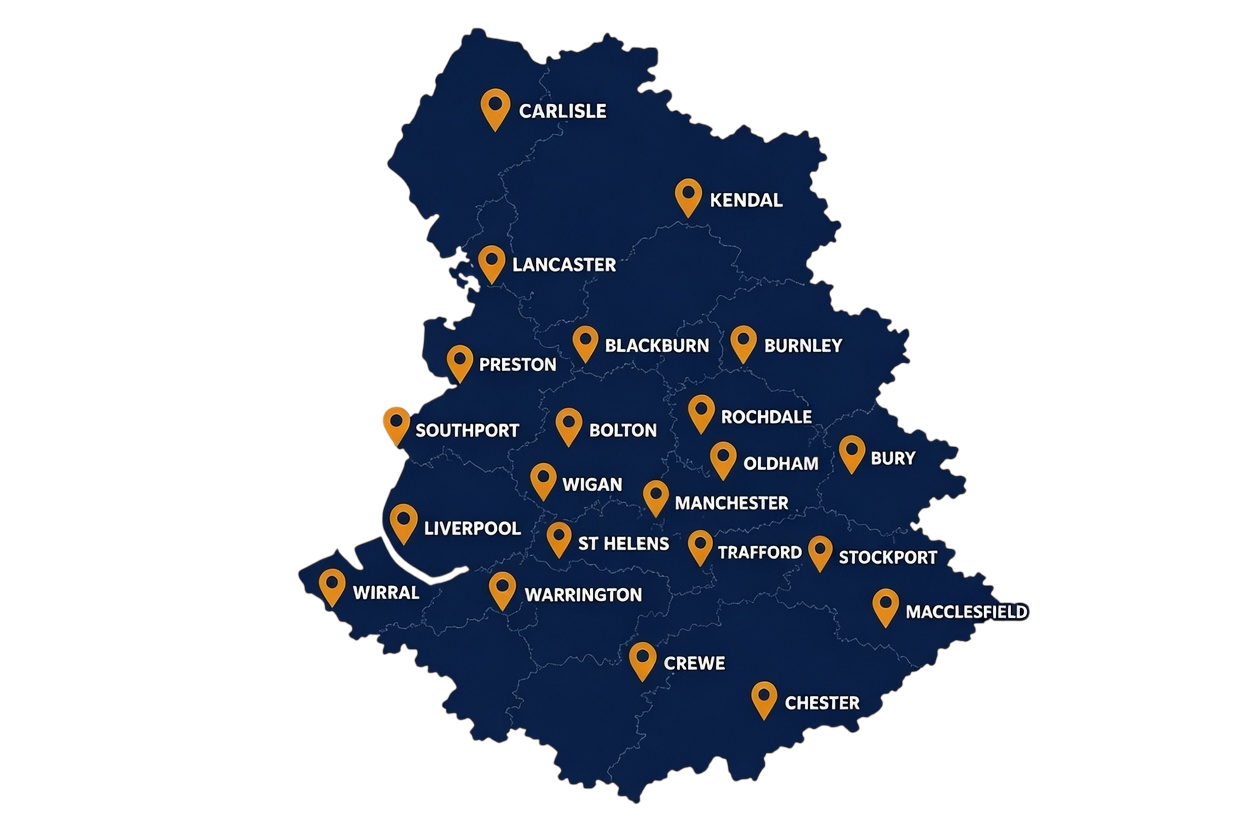
Greater Manchester — Manchester city centre, Salford, Trafford Park, Stockport, Oldham, Rochdale, Bolton, Bury, Wigan, Tameside and all surrounding areas. Manchester's extensive Victorian and post-war commercial building stock means asbestos-containing materials are encountered regularly across city centre conversion projects, industrial estate refurbishments and housing developments.
Merseyside — Liverpool city centre, Wirral, Knowsley, St Helens, Sefton and surrounding areas. Liverpool's wealth of older commercial properties, port-related industrial buildings and post-war housing stock makes asbestos disposal a frequent requirement across the region.
Lancashire — Preston, Blackburn, Burnley, Lancaster, Chorley, Leyland and surrounding towns. Lancashire's industrial heritage means asbestos-containing materials are commonly found in older mill buildings, warehouses and industrial premises across the county.
What BWSL Includes With Every Asbestos Waste Collection
Appropriate containers and packaging — asbestos waste bags, bulk containers and dedicated asbestos skips supplied where required
EA-registered and ADR-certified carriers — every collection partner holds appropriate Environment Agency licensing and ADR certification for asbestos waste
Fully compliant consignment notes — completed automatically on every collection, signed by both producer and carrier, retained for three years
EA-permitted disposal — all asbestos waste routed to facilities with specific Environment Agency authorisation for asbestos-containing materials
Certificates of disposal — confirming waste type, weight, collection date and disposal site
Emergency collections — available across the North West when unexpected asbestos is encountered mid-project
30 day rolling notice — cancel or amend with just 30 days notice, no exit fees, no penalties
One invoice — asbestos disposal alongside any other waste streams, all consolidated
Free waste consultation — we advise on correct packaging requirements and documentation before any collection is arranged
The Real Consequences of Incorrect Asbestos Waste Disposal
Asbestos waste offences attract some of the most severe penalties in UK environmental and health and safety law:
Unlimited criminal fines — there is no cap on fines for asbestos waste offences under the Environmental Protection Act 1990 and the Control of Asbestos Regulations 2012. Fines of tens and hundreds of thousands of pounds are regularly imposed.
Custodial sentences — individual directors and business owners can face imprisonment for the most serious asbestos waste offences. The courts treat the illegal disposal of asbestos waste as a serious matter given the public health risk.
HSE investigation and enforcement — the Health and Safety Executive takes active interest in asbestos waste management and has extensive investigative powers. HSE improvement notices and prohibition notices can shut down construction projects immediately.
Remediation liability — asbestos contamination of land requires specialist remediation that can cost tens or hundreds of thousands of pounds. The polluter bears this liability.
Industry blacklisting — contractors found to have illegally disposed of asbestos waste face significant reputational damage in an industry where tendering for public and commercial contracts requires a clean compliance record.
Frequently Asked Questions — Asbestos Waste Disposal North West
-
No — BWSL arranges the licensed collection, transport and disposal of asbestos waste after licensed removal work has been completed. Asbestos removal must be carried out by an HSE-licensed asbestos removal contractor. We can recommend licensed removal contractors across the North West and coordinate with them to arrange disposal once removal is complete.
-
A fully compliant hazardous waste consignment note is issued on every collection, confirming the waste type, quantity, collection date, carrier details and receiving disposal facility. A certificate of disposal is also provided confirming the disposal site and method. Both documents should be retained for a minimum of three years.
-
No. Asbestos waste must be collected by a carrier holding an appropriate Environment Agency waste carrier licence. The carrier must also meet ADR requirements for the transport of dangerous goods. An unlicensed carrier collecting asbestos waste is committing an offence — and using one creates legal liability for you as the producer.
-
From single bags of asbestos-containing materials from a small refurbishment to multiple skips of waste from a large demolition project — BWSL arranges asbestos waste disposal for projects of all sizes across the North West.
-
In most cases within 24–72 hours of enquiry for standard collections. Emergency same-day collections are available across the North West when unexpected asbestos is encountered mid-project and work needs to stop immediately.
-
No. Asbestos waste must not be mixed with general waste in a standard skip. It requires dedicated packaging, a dedicated licensed carrier and a specific disposal facility authorised to accept asbestos-containing materials. Mixing asbestos with general waste contaminates the entire load and creates serious additional costs and legal liability.
-
If asbestos-containing materials have already been identified and removed by a licensed contractor, BWSL can arrange disposal directly. If you suspect your property contains asbestos but haven't had a survey, you'll need a qualified asbestos surveyor to identify and assess the materials before removal and disposal can proceed.
-
Greater Manchester, Merseyside, Lancashire, Cheshire and Cumbria — including all major cities and towns. Get in touch to confirm coverage for your specific location.
-
Yes — for construction and demolition projects generating multiple waste streams, BWSL can coordinate asbestos disposal alongside general construction waste, hazardous waste and WEEE on one invoice.
-
BWSL's network buying power and relationships with licensed asbestos waste carriers and permitted disposal facilities across the North West typically result in more competitive pricing than businesses achieve going direct. Get a free quote and see.
Get Your Free Asbestos Waste Disposal Quote Today
Whether you're a developer uncovering asbestos in a city centre conversion, a roofing contractor removing asbestos cement sheets, a facilities manager arranging planned asbestos removal or a property owner dealing with unexpected asbestos discovery — BWSL arranges licensed, compliant asbestos waste disposal across the North West quickly, professionally and at a competitive price.
Licensed carriers. EA-permitted disposal. Consignment notes on every collection. Emergency collections available. 30 day rolling notice.