
Confidential Document Destruction North West
Every North West business generates confidential waste. Customer records, employee files, financial statements, legal documents, medical records, supplier contracts — sensitive information that builds up quietly in filing cabinets, desk drawers, storage rooms and printer trays across every office, surgery, school and professional practice in the region.
The problem isn't that businesses don't know they should destroy it securely. The problem is that most don't fully understand what secure destruction legally means, what the consequences of getting it wrong actually look like, or whether their current shredding arrangement actually meets the standard the law requires.
Putting confidential documents in a recycling bin is not secure destruction. A desk-side office shredder producing strip-cut shreds is not secure destruction by GDPR standards. A clearance company removing filing cabinets without a certificate of destruction is not a defensible data protection process.
BWSL arranges genuinely secure, certificated confidential document destruction for businesses across the entire North West — free locked consoles supplied, GDPR-compliant shredding to recognised security standards, a certificate of destruction on every single collection and savings of 15–25% on what most businesses are currently paying for the same service.
30 day rolling notice. No long-term contracts. One simple monthly invoice.
Need an Instant Quote?
The Legal Framework Around Confidential Document Destruction
Understanding why confidential document destruction is a legal obligation — not just a best practice — is the starting point for getting it right. The legal framework is more comprehensive than most businesses realise.
The UK General Data Protection Regulation and the Data Protection Act 2018 together establish the legal framework for how personal data must be handled, stored and destroyed by organisations operating in the UK. Article 5 of UK GDPR requires that personal data is kept "in a form which permits identification of data subjects for no longer than is necessary" — in plain English, data must be securely destroyed when it is no longer needed.
Article 5 also requires that personal data is processed with "appropriate security" — including protection against "unauthorised or unlawful processing" and "accidental loss, destruction or damage." Disposal of paper records containing personal data into a recycling bin or general waste stream does not meet this standard. It is an Article 5 breach.
The consequences are significant. The Information Commissioner's Office can issue fines of up to £17.5 million or 4% of global annual turnover — whichever is higher — for serious breaches. Even minor breaches carry fines of up to £8.7 million or 2% of global turnover.
UK GDPR and the Data Protection Act 2018
BS EN 15713 is the British and European standard for the secure destruction of confidential material. It sets out the security, operational and procedural requirements that a confidential shredding provider must meet — from how staff are vetted and trained, to how vehicles are secured, how destruction is carried out and how certificates of destruction are issued.
Working with a BS EN 15713-compliant provider is the clearest way to demonstrate to an ICO auditor, a client or a regulatory body that your confidential document destruction meets the required standard. BWSL works exclusively with BS EN 15713-accredited partners across the North West.
BS EN 15713 — The Secure Destruction Standard
DIN 66399 is the international standard that classifies the security level of shredded material by the size of the particles produced. There are seven security levels — P-1 through P-7 — ranging from basic strip cutting to micro-cut destruction that renders material completely unrecoverable.
Most businesses across the North West should be shredding to at least P-4 or P-5 security level:
P-4 — particles no larger than 160mm². Suitable for internal documents, general business records and most commercial confidential material. The minimum standard most businesses should be working to.
P-5 — particles no larger than 30mm². Suitable for confidential business documents, personal data and anything that would cause significant harm if reconstructed. Recommended for healthcare, legal, financial and HR records.
P-6 and P-7 — ultra-high security levels used primarily by government and defence organisations. Not typically required for commercial businesses.
An office shredder producing long strip-cut shreds almost certainly does not meet P-4 standard — strip shreds are easily reconstructed and are not considered secure destruction under GDPR or BS EN 15713.
DIN 66399 — Shredding Security Levels
The Confidentiality Obligation in Professional Sectors
Beyond GDPR, several professional sectors operating across the North West carry additional confidentiality obligations that make secure document destruction a specific regulatory requirement:
Healthcare — the Common Law Duty of Confidentiality and NHS information governance requirements mean patient records must be destroyed to a demonstrably secure standard. CQC inspects this.
Legal — solicitors are bound by the Solicitors Regulation Authority's confidentiality obligations. Documents containing client information must be destroyed securely and a destruction record maintained.
Financial services — FCA-regulated firms have specific obligations around data security and destruction of client financial records.
HR and Employment — employee records containing personal data — salaries, disciplinary records, medical information, right-to-work documents — must be destroyed securely when retention periods expire.
BWSL provides certificated destruction that meets the requirements of all of the above — in a single, simple, scheduled service.
What Counts as Confidential Waste — and What Most Businesses Miss
Most businesses have a good instinct for the obvious confidential documents — patient records, bank statements, HR files. What they consistently miss is the volume and variety of confidential material that builds up in day-to-day operations without being immediately obvious.
Documents most businesses correctly identify as confidential:
Customer and client personal data — names, addresses, contact details, account information
Employee records — payroll, disciplinaries, medical information, contracts
Financial records — bank statements, invoices containing personal data, accountancy records
Medical and patient records — in healthcare settings
Legal documents — contracts, correspondence, court papers
Documents most businesses incorrectly treat as non-confidential:
Business cards — contain personal contact information of individuals
Printed emails — may contain personal data, financial details or commercially sensitive information
Draft documents — early versions of contracts, proposals or reports often contain sensitive information
Sticky notes and handwritten notes — frequently contain passwords, personal details or sensitive operational information
Envelopes with names and addresses — personal data under GDPR
Promotional material with barcodes — may contain embedded customer data
Computer printouts and photocopier test pages — these frequently contain personal data from the last document copied
Old headed notepaper and out-of-date forms — contain company information that could be used fraudulently
ID documents and right-to-work documents from former employees — highly sensitive personal data
The volume of genuinely confidential material most businesses generate — once you correctly identify everything that qualifies — is almost always significantly higher than they estimated.
What About Digital Media?
Confidential waste isn't just paper. Hard drives, USB sticks, DVDs, CDs, backup tapes and mobile phones all contain data that must be securely destroyed at end of life. Simply deleting files or formatting a drive does not destroy the data — it remains recoverable with readily available tools.
BWSL can arrange certified destruction of digital media alongside paper shredding — hard drives degaussed and shredded, USB and optical media physically destroyed, certificates of destruction provided. Contact us to discuss your specific requirements.
Types of Confidential Document Destruction Service
Not every North West business has the same confidential waste requirements. BWSL provides three distinct service types to match different needs:
-
The standard service for most North West businesses — locked consoles placed at strategic points around your premises into which staff deposit confidential documents throughout the working week. Collections arranged on a schedule — weekly, fortnightly or monthly — that matches your output volume.
Free consoles in a range of sizes supplied at no cost. When collected, the entire contents are taken for secure destruction at a BS EN 15713-accredited facility and a certificate of destruction issued to you.
This is the most cost-effective and most secure approach for the majority of businesses — significantly more secure than office shredders (which are operated inconsistently by staff, produce lower security-level shreds and require staff time to operate) and more convenient than bag-based systems.
-
For businesses with occasional rather than regular confidential waste needs — an annual clear-out, an office move, a merger or acquisition, a period-end document purge or the clearance of a storage room — BWSL arranges one-off collections across the North West with as little as 24 hours notice in most cases.
Bags and sacks supplied, collection arranged, secure destruction carried out and a certificate of destruction issued. No ongoing commitment required.
-
For businesses or individuals with specific security requirements — legal firms handling particularly sensitive matters, financial institutions, healthcare organisations, government contractors — BWSL can arrange on-site witnessed shredding. A mobile shredding vehicle attends your premises, documents are fed into the shredder in your presence and a certificate of destruction is issued immediately.
On-site shredding is the highest-security option available and gives complete chain-of-custody assurance — the documents never leave your site before destruction.
What Every BWSL Confidential Destruction Collection Includes
Free locked consoles — in a range of sizes to suit your premises, supplied and maintained at no cost, branded if required
BS EN 15713-compliant destruction — all collections processed at accredited facilities meeting the recognised secure destruction standard
P-4 or P-5 security level shredding — cross-cut or micro-cut destruction, not strip shredding, as standard
Certificate of destruction on every collection — issued automatically, not on request, confirming the date, weight and destruction method
DBS-checked collection staff — every operative handling your confidential waste is DBS checked
GPS-tracked vehicles — your material is tracked from collection to destruction
30 day rolling notice — cancel or amend your service with just 30 days notice, no exit fees, no penalties
One monthly invoice — confidential shredding alongside any other waste streams, all on one simple bill
£10 million liability cover — on every collection
100% recycling of shredded material — all shredded paper is baled and sent for recycling — your confidential waste destruction also contributes to your sustainability targets
The BWSL Plant a Tree Scheme — For regular material processed earns your business a native British tree planted in the UK
Confidential Document Destruction for Every North West Sector
-
![Close-up of a person writing with a pen at a desk with papers and a pair of glasses.]()
Legal Practices
Solicitors, barristers, legal executives and law firms across the North West handle some of the most sensitive personal and commercial information of any business type — client instructions, witness statements, court documents, property transactions, wills and trusts. The Solicitors Regulation Authority's confidentiality requirements mean secure destruction isn't optional — it's a professional obligation.
BWSL provides legal practices across Greater Manchester, Merseyside and Lancashire with regular locked console collections, P-5 security level shredding and certificates of destruction suitable for SRA compliance purposes.
-
![A person in a light blue button-up shirt is pressing the keys on a calculator with their right hand, holding a pen in the left hand, on a wooden desk with papers and a black folder.]()
Accountancy & Financial Services
GP surgeries, dental practices, care homes, pharmacies and private clinics generate paper-based patient records, referral letters, prescription records and clinical correspondence alongside their clinical waste. The Common Law Duty of Confidentiality means patient information requires the same level of secure destruction as personal data under GDPR — both standards apply simultaneously.
BWSL coordinates confidential shredding for healthcare practices across the North West alongside clinical waste collections — consolidating both services onto one invoice and one collection schedule where possible.
-
![Two professionals, a woman with blonde hair and a man with dark hair and glasses, working together at a desk in an office. The woman is holding a pen and looking at documents, while the man has a disposable coffee cup in front of him. There is a laptop and other office supplies on the desk.]()
HR Departments & Recruiters
HR records — job applications, interview notes, disciplinary records, salary information, right-to-work documents and medical information provided by employees — are among the most sensitive personal data any organisation holds. Under UK GDPR, most HR records must be destroyed within defined periods after an employee leaves.
BWSL helps businesses across the North West manage HR record destruction — both through regular scheduled console collections for ongoing HR waste and through periodic purge collections when retention periods expire.
-
![A classroom filled with young students raising their hands, with a teacher standing at the chalkboard. The classroom has colorful decorations, including a string of multicolored triangular flags hanging above the blackboard, and world maps on the walls.]()
Education — Schools, Colleges & Universities
Educational institutions across the North West hold significant volumes of confidential data about students, parents and staff — exam results, SEND records, safeguarding files, financial information and HR records. The obligation to protect this data extends fully to destruction — and Ofsted inspections increasingly check data handling and destruction practices.
BWSL provides confidential shredding for educational institutions across the North West arranged around term dates and academic calendars — ensuring collections don't disrupt school life while maintaining full compliance.
-
![Crowd of people at a busy train station with stairs, escalators, and a London Underground sign.]()
Retail & E-Commerce
Retailers and e-commerce businesses handle customer data — order details, payment records, delivery addresses, loyalty scheme information and returns documentation — that must be securely destroyed when no longer needed. Many retailers are also subject to PCI DSS (Payment Card Industry Data Security Standard) requirements that impose specific obligations on the handling and destruction of card payment information.
BWSL serves retail businesses across the North West with flexible console and bag-based collections — scalable to seasonal fluctuations in document volumes.
-
![A man sitting on a wooden desk in a modern office, holding papers and a pen, with a cluttered workspace and shelves with decorative plants, books, and a clock in the background.]()
Estate Agents & Property Professionals
Estate agents, letting agents, conveyancers and property managers handle a significant volume of personal data — identification documents, financial statements, mortgage details, tenancy agreements and correspondence. This is particularly sensitive as it often includes copies of passports, driving licences and bank statements provided for right-to-rent checks and affordability assessments.
BWSL provides secure destruction for property professionals across the North West — ensuring client identity documents and financial records are destroyed to a standard that protects both the client and the business.






The Real Cost of Getting Confidential Document Destruction Wrong
Most North West businesses understand that a data breach is a problem. What many underestimate is how easily a confidential document destruction failure becomes a reportable data breach — and what the consequences actually look like in practice.
The Information Commissioner's Office takes disposal of personal data seriously. Documented cases of ICO enforcement involving improper document disposal include fines for businesses that disposed of client files in general waste bins, leaving staff records in recycling and failing to verify the credentials of third-party document disposal companies. Fines range from thousands to millions of pounds depending on severity.
ICO enforcement action
For professional services firms — solicitors, accountants, financial advisers, healthcare providers — a data breach resulting from improper document disposal can be career-ending as well as financially significant. Clients expect their information to be protected.
Reputational damage
Under UK GDPR, a personal data breach — including improper disposal of documents containing personal data — must be reported to the ICO within 72 hours if it is likely to result in a risk to individuals' rights and freedoms. Failure to report a notifiable breach is itself a separate breach and carries additional penalties.
Mandatory reporting
Many commercial contracts include data processing provisions that impose liability on the party responsible for a data breach. A business that suffers a breach due to improper document disposal may find itself liable to clients under contract as well as to individuals under data protection law.
Client contractual liability
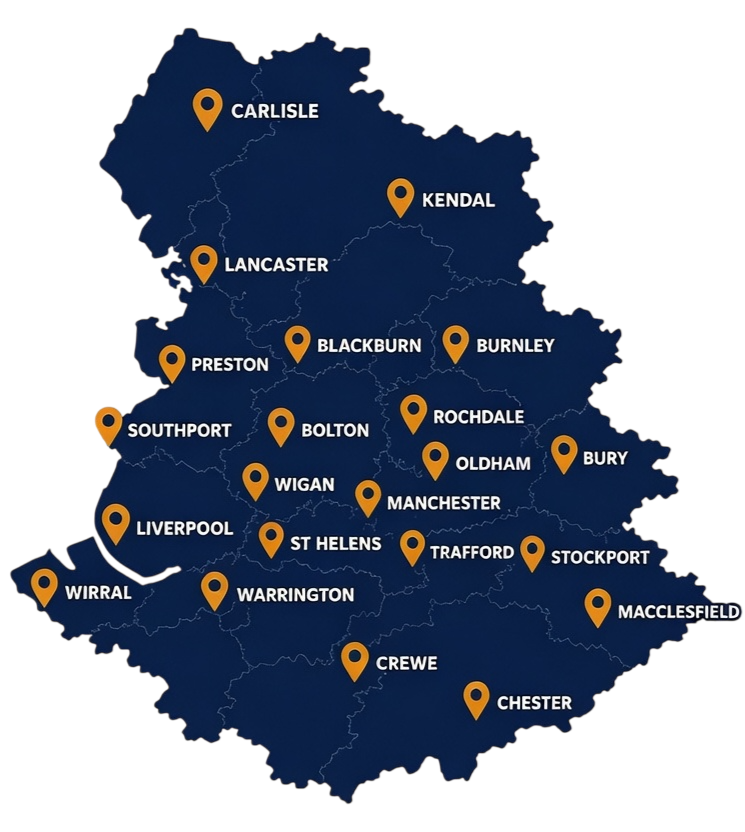
Confidential Document Destruction Across the North West
BWSL arranges confidential document destruction services across the entire North West region:
Greater Manchester
Manchester, Salford, Trafford, Stockport, Oldham, Rochdale, Bolton, Bury, Wigan, Tameside and all surrounding areas
Merseyside
Liverpool, Wirral, Knowsley, St Helens, Sefton and surrounding areas
Lancashire
Preston, Blackburn, Burnley, Lancaster, Chorley, Leyland, Accrington and surrounding towns
Cheshire
Warrington, Chester, Crewe, Macclesfield, Ellesmere Port, Northwich and surrounding areas
Cumbria
Carlisle, Kendal, Barrow-in-Furness and surrounding areas
Frequently Asked Questions — Confidential Document Destruction North West
-
Putting confidential documents in a recycling bin is not secure destruction under GDPR. Recycled paper is processed by multiple parties before it becomes new material — any of whom could access the information. Certified shredding destroys documents to a recognised security standard at an accredited facility with a documented chain of custody. Only certificated shredding provides a defensible GDPR-compliant destruction record.
-
Most businesses should shred to P-4 or P-5 under DIN 66399. P-4 is the minimum for general confidential commercial material — particles no larger than 160mm². P-5 is recommended for healthcare, legal, financial and HR records — particles no larger than 30mm². BWSL provides P-4 and P-5 shredding as standard.
-
A certificate of destruction confirms that your confidential material was collected, transported securely and destroyed at an accredited facility to a specified security standard on a specified date. It is your documented evidence of GDPR-compliant disposal — essential in the event of an ICO audit, a client query or a contractual dispute. BWSL issues certificates of destruction automatically on every collection.
-
Yes — locked consoles in a range of sizes are supplied completely free of charge. No rental fees, no deposit, delivered to your premises prior to your first collection.
-
No. BWSL operates on a 30 day rolling notice period. Cancel or amend your confidential shredding service with just 30 days notice — no exit fees, no penalties.
-
Yes — BWSL arranges one-off collections across the North West for office clearances, periodic purges and occasional requirements. Contact us and we can usually arrange collection within 24–48 hours.
-
Yes — BWSL can arrange certified destruction of hard drives, USB sticks, CDs, DVDs and other digital media alongside paper shredding. Contact us to discuss your specific digital media destruction requirements.
-
Yes — all operatives handling confidential waste are DBS checked as standard.
-
All shredded material is baled and sent for recycling — your confidential waste destruction contributes to your sustainability targets while meeting your data protection obligations. A certificate of destruction confirms the destruction method and the recycling outcome.
-
Consoles are typically delivered within 48 hours of accepting your quote. Your first collection is usually scheduled within 5–7 working days.
-
Yes — BWSL regularly manages multi-site confidential shredding for businesses with several locations across the North West, consolidating all sites onto one monthly invoice.
-
BWSL works with a vetted network of BS EN 15713-accredited shredding partners across the North West. We consolidate client volumes to negotiate rates that individual businesses can't access alone. Most clients save 15–25% compared to what they were previously paying national providers.
Get Your Free Confidential Document Destruction Quote Today
Whether you need regular locked console collections for ongoing confidential waste, a one-off office clearance, on-site witnessed shredding or certified digital media destruction — BWSL has the network, the compliance credentials and the buying power to manage it better and cheaper than you're currently doing it.
Free consoles. Certificated destruction on every collection. GDPR and BS EN 15713 compliant. 30 day rolling notice. One invoice.