
Hazardous Waste Disposal North West
Hazardous waste is one of the most tightly regulated categories of commercial waste in the UK — and one of the most commonly mishandled. Chemicals, solvents, oils, paints, batteries, fluorescent tubes, asbestos-containing materials, WEEE and dozens of other substances produced by North West businesses every day carry legal obligations that most business owners underestimate until something goes wrong.
The consequences of mishandling hazardous waste are more serious than for any other waste stream. Environment Agency fines are unlimited. Criminal prosecution of individual directors and business owners is routine in serious cases. And unlike general waste compliance failures — which are usually discovered during an audit — hazardous waste incidents often become public, because contamination, illegal dumping or transport accidents are visible in a way that missing paperwork is not.
BWSL arranges licensed hazardous waste disposal for businesses of every size across the entire North West — manufacturers, construction companies, automotive businesses, laboratories, healthcare facilities, offices, retailers and more. Specialist containers supplied, EA-registered and ADR-certified carriers on every collection, full consignment notes issued automatically and savings of 15–25% on what most businesses are currently paying.
30 day rolling notice. No long-term contracts. One simple monthly invoice.
Need an Instant Quote?
The Legal Framework Around Hazardous Waste — What North West Businesses Must Know
Hazardous waste sits within the most heavily regulated area of UK environmental law. Understanding the framework isn't optional for any business that produces it — ignorance of the law is not a defence the Environment Agency or a court will accept.

The Carriage of Dangerous Goods Regulations and ADR
Hazardous waste is classified as dangerous goods for transport purposes under the Carriage of Dangerous Goods and Use of Transportable Pressure Equipment Regulations 2009, which implement the international ADR agreement in UK law. This means:
Vehicles transporting hazardous waste must be ADR-equipped with appropriate safety equipment, fire suppression and marking
Drivers must hold a current ADR certificate — a specialist qualification that covers the safe transport of dangerous goods by road
Waste must be packaged in UN-approved containers appropriate for the specific hazard class
Transport documentation must accompany every movement of hazardous waste
An unlicensed carrier transporting your hazardous waste without ADR certification is committing a criminal offence — and so are you if you arranged for them to do so knowingly. BWSL uses only EA-registered, ADR-certified collection partners on every hazardous waste movement.

The Hazardous Waste Regulations 2005
The Hazardous Waste Regulations 2005 are the primary piece of legislation governing hazardous waste management in England. They define what constitutes hazardous waste, how it must be classified, stored, transported, documented and disposed of, and what obligations fall on businesses as waste producers.
Under these regulations, businesses producing more than 500kg of hazardous waste per year were previously required to register as hazardous waste producers. This registration requirement was removed in 2016 — but the duty of care obligations that go with producing hazardous waste remain fully in force regardless of volume.

The Environmental Protection Act 1990 — Duty of Care
The Environmental Protection Act 1990 establishes the overarching duty of care for all waste — including hazardous waste. The duty applies from the moment hazardous waste is produced until it reaches its final, permitted disposal point. As the producer, you are legally responsible for ensuring your hazardous waste is correctly classified, correctly packaged, stored safely, collected only by a licensed and appropriately permitted carrier, and disposed of at a facility authorised to accept it.
Critically — the duty of care does not end when the waste leaves your premises. If your hazardous waste is subsequently fly-tipped, illegally disposed of or traced to an unpermitted site, you as the producer can be held liable even if you didn't physically handle the disposal. Choosing an EA-registered, appropriately-permitted carrier is not just good practice — it is how you protect yourself legally.

Consignment Notes — The Non-Negotiable Documentation Requirement
Every movement of hazardous waste in England must be accompanied by a consignment note. This is not optional, it is not a best practice and it is not something you can retrospectively produce if asked. The consignment note must:
Be completed before the waste is collected
Accurately describe the waste including its European Waste Catalogue (EWC) code
Identify the producer, the carrier and the receiving facility
Be signed by both the producer and the carrier at the point of collection
Be retained by the producer for a minimum of three years
A business that cannot produce consignment notes for its hazardous waste collections is non-compliant — regardless of how long it has been operating or how reputable it believes its carrier to be. BWSL issues fully compliant consignment notes automatically on every single hazardous waste collection.
Hazardous waste is defined as waste that displays one or more hazardous properties listed in UK waste legislation — including being explosive, flammable, oxidising, toxic, harmful, corrosive, irritant, carcinogenic, infectious or ecotoxic. The classification system uses European Waste Catalogue codes — six-digit cxodes that identify the type and source of waste and whether it is classified as hazardous.
Here's a comprehensive guide to the most common hazardous waste streams produced by North West businesses:
What Counts as Hazardous Waste — The Complete Classification Guide
-
Halogenated and non-halogenated solvents — acetone, methanol, toluene, xylene, white spirit, cleaning solvents and solvent-contaminated materials including rags, absorbents and packaging. Produced by manufacturing, printing, automotive, cleaning and laboratory businesses across the North West.
Solvent waste must be stored in sealed, compatible containers away from ignition sources. Halogenated and non-halogenated solvents must be kept separate — mixing them changes their classification and complicates disposal.
-
Engine oil, hydraulic oil, gear oil, cutting fluids, transformer oil and other mineral and synthetic oils. Produced by automotive workshops, engineering firms, manufacturing sites and transport companies across the North West.
Waste oil has genuine recovery value — most waste oil is re-refined rather than disposed of. This makes it one of the more straightforward hazardous waste streams to manage, but it still requires a licensed carrier and consignment note on every movement.
-
Solvent-based paints, varnishes, lacquers, adhesives and resins — both in liquid form and as dried/cured waste. Water-based paints are generally not classified as hazardous, but solvent-based products almost always are. Produced by manufacturing, construction, automotive refinishing and print businesses.
Containers of solvent-based paint — even partly empty — must be treated as hazardous waste and disposed of through a licensed route.
-
All batteries containing lead-acid, nickel-cadmium, lithium or mercury are classified as hazardous waste. This includes vehicle batteries, industrial batteries, portable batteries from offices and retail environments, and UPS batteries. Produced by virtually every business type across the North West in varying quantities.
Battery collection is one of the most overlooked hazardous waste obligations — many businesses accumulate batteries in a drawer or storeroom without realising they have a legal obligation to dispose of them through a licensed hazardous waste route.
-
Fluorescent tubes, compact fluorescent lamps, high-intensity discharge lamps and any lamp containing mercury are classified as hazardous waste. LED bulbs are generally not hazardous, but must still be disposed of through WEEE routes. Produced by virtually all commercial premises across the North West.
Fluorescent tubes are fragile — broken tubes release mercury vapour, making breakage during storage or collection a health and safety incident as well as an environmental concern. BWSL provides appropriate transport packaging for fluorescent tube collections.
-
Computers, monitors, servers, printers, photocopiers, televisions, mobile phones, small appliances and all other electrical and electronic equipment contain hazardous components — lead, mercury, cadmium, hexavalent chromium and flame retardants — that prevent disposal through general waste streams.
WEEE must be collected separately and sent to authorised WEEE treatment facilities. Most North West businesses generate WEEE regularly through equipment upgrades, office moves and end-of-life replacements. BWSL coordinates WEEE collections across the North West — from single items to full office clearances.
-
Laboratory chemicals, industrial cleaning chemicals, acids, alkalis, oxidising agents and chemical mixtures from manufacturing, laboratory and industrial processes. This is one of the most varied and complex hazardous waste streams — different chemicals require different packaging, different transport classifications and different disposal routes.
Accurate characterisation of chemical waste is critical — the EWC code assigned must correctly reflect the composition and hazard properties of the waste. BWSL works with clients to correctly classify chemical waste streams before arranging collection, ensuring consignment notes are accurate and disposal is through an appropriately permitted facility.
-
Cytotoxic and cytostatic medicines, radioactive materials (under specific licensing), mercury-containing equipment, fixatives, stains and chemical reagents from healthcare and laboratory settings. These require specific disposal routes and specialist containers — purple-lidded containers for cytotoxic waste, specialist containers for mercury and radioactive materials.
Hazardous Waste Storage — Legal Requirements and Practical Guidance
Correct storage of hazardous waste between production and collection is a legal requirement and a practical safety necessity. Poor storage is one of the most common compliance failures the Environment Agency finds during site inspections. Here's what the law requires and what BWSL recommends:
Segregation
Different categories of hazardous waste must be stored separately. Incompatible materials — for example, acids and alkalis, or oxidising agents and flammable materials — must never be stored together. Mixing hazardous waste streams is illegal, changes the waste classification and can cause dangerous chemical reactions.
Labelling
Every hazardous waste container must be clearly labelled with the contents, the hazard classification and appropriate hazard warning symbols. Unlabelled hazardous waste containers are a compliance failure and a safety risk.
Compatible Containers
Hazardous waste must be stored in containers that are compatible with the material — UN-approved containers for transport, appropriate material for the substance (for example, certain chemicals attack plastic containers). Leaking or damaged containers are a legal liability and an environmental incident waiting to happen.
Time Limits
Hazardous waste cannot be stored indefinitely. In most cases, hazardous waste should be collected within 12 months of production. Accumulating large quantities of hazardous waste on site increases both the risk of incident and the regulatory exposure.
Bunded Storage Areas
Liquid hazardous waste should be stored in a bunded area — a secondary containment that would capture the contents of the largest container in the event of a leak or spill. The bund must hold at least 110% of the volume of the largest container or 25% of the total storage volume, whichever is greater.
Hazardous Waste Disposal for Every North West Sector
-
![A person wearing gloves welding metal on a workbench in a workshop.]()
Manufacturing and Industrial
The North West's manufacturing sector — concentrated in Trafford Park, Knowsley, Leyland, Chorley and across the region's industrial estates — produces some of the highest hazardous waste volumes of any sector. Solvents, oils, chemical waste, contaminated packaging, WEEE and process-specific waste streams all require licensed disposal.
BWSL works with manufacturing clients across the North West to audit every hazardous waste stream, ensure correct EWC classification, arrange appropriately-permitted collections and provide consignment notes that stand up to Environment Agency scrutiny. For high-volume producers, scheduled regular collections reduce the compliance burden and ensure waste never accumulates beyond safe storage limits.
-
![A mechanic inspecting the engine of a car in a garage.]()
Automotive and Vehicle Maintenance
Automotive workshops, dealerships, bodyshops and vehicle maintenance businesses across the North West generate waste oil, solvent-based cleaning products, paints and coatings, contaminated absorbents and batteries in significant volumes. The automotive sector is one of the most frequently inspected by the Environment Agency for hazardous waste compliance.
BWSL arranges waste oil collections, solvent waste collections, battery collections and WEEE collections for automotive businesses across Greater Manchester, Merseyside, Lancashire and Cheshire — all consolidated onto one invoice with full consignment note documentation.
-
![An aerial view of a construction site with building structures, construction equipment, materials, and a tower crane.]()
Construction and Demolition
Construction and demolition projects across the North West generate asbestos-containing materials, solvent-based adhesives, paints and coatings, fluorescent tubes, batteries, contaminated soil and WEEE from removed equipment. Managing hazardous waste on a live construction site requires careful planning — the right containers on site before work starts, collections timed to project phases and documentation that protects contractors from fly-tipping liability.
BWSL works with construction companies and project managers across the North West to plan hazardous waste management from project start — supply containers in advance, arrange collections around project timelines and ensure full compliance from groundworks to completion.
-
![A scientist wearing protective gear and blue gloves works in a laboratory, pipetting a blue liquid into test tubes, with a computer monitor displaying a scientific visualization in the background.]()
Laboratories and Research Facilities
The North West's universities, hospital laboratories, pharmaceutical facilities and diagnostic laboratories generate some of the most complex and varied hazardous waste streams of any sector — chemical waste, biological materials, radioactive materials (under specific licensing), cytotoxic substances, solvents and contaminated equipment.
Each stream requires specific characterisation, specific containers and often specific permitted disposal facilities. BWSL works with laboratory clients to ensure every stream is correctly classified and routed to an appropriate facility — contact us to discuss your specific laboratory waste requirements.
-
![Medical professionals performing surgery on a patient in an operating room.]()
Healthcare and Pharmaceutical
In addition to clinical waste, healthcare facilities and pharmaceutical businesses across the North West generate hazardous waste including cytotoxic and cytostatic medicines, mercury-containing equipment, chemical fixatives and reagents.
BWSL coordinates hazardous waste alongside clinical waste collections for healthcare clients — ensuring every waste stream from a healthcare facility reaches the correct disposal route through a single managed service.
-
![A man with glasses and a plaid shirt is pouring red paint from a container into a paint sprayer machine in a workshop.]()
Printing and Graphic Arts
Printing businesses across the North West generate solvent-based inks, cleaning solvents, contaminated rags and photochemicals that are classified as hazardous waste. Many small and medium-sized printers are unaware of the specific EWC codes that apply to their waste streams or that their solvent-contaminated cleaning materials require consignment notes.
BWSL works with print businesses across Greater Manchester and beyond to identify every hazardous waste stream, assign correct EWC codes and arrange appropriately permitted collections.
-
![Crowded train station with escalators and stairs filled with people walking in various directions, with signs for London Travel Information and the Underground subway visible.]()
Retail and Hospitality
Many retail and hospitality businesses don't think of themselves as hazardous waste producers — but fluorescent tubes, batteries, WEEE from kitchen and bar equipment, refrigerant-containing appliances and solvent-based cleaning products are all produced in this sector in significant quantities.
BWSL helps retail and hospitality businesses across the North West identify their hazardous waste streams — often for the first time — and arrange compliant, cost-effective collections alongside their general waste and recycling.
-
![An open-plan office with employees working at desks with computer monitors, under exposed ceiling pipes and industrial lighting fixtures.]()
Offices and Commercial Premises
Offices generate more hazardous waste than most people realise — batteries from equipment, fluorescent tubes, WEEE from regular IT upgrades, toner cartridges containing hazardous components and chemical cleaning products. Most office hazardous waste accumulates gradually in cupboards and storerooms rather than building up in obvious ways.








Our Hazardous Waste Disposal Service — What's Included
Every BWSL hazardous waste collection across the North West includes:
Correct UN-approved containers — supplied for every waste stream in appropriate sizes and materials, at no cost
EWC code classification support — we help you correctly identify the European Waste Catalogue code for every hazardous waste stream before collection
EA-registered and ADR-certified carriers — every collection partner holds appropriate Environment Agency registration and current ADR certification
Fully compliant consignment notes — completed and issued automatically on every collection, signed by both producer and carrier, retained on your behalf for three years
EA-permitted disposal facilities — all hazardous waste routed to appropriately permitted treatment and disposal facilities only
Certificates of disposal — confirming the waste type, weight, collection date and disposal method on every collection
30 day rolling notice — cancel or amend any collection with just 30 days notice, no exit fees, no penalties
One monthly invoice — hazardous waste alongside any other streams, all on one simple bill
Same-day emergency collections — available across the North West for urgent hazardous waste situations
Free waste audit — including EWC code review and storage compliance check before any collection is arranged
The BWSL Plant a Tree Scheme — every tonne diverted from landfill earns your business a native British tree planted in the North West
Hazardous Waste Disposal Across the North West
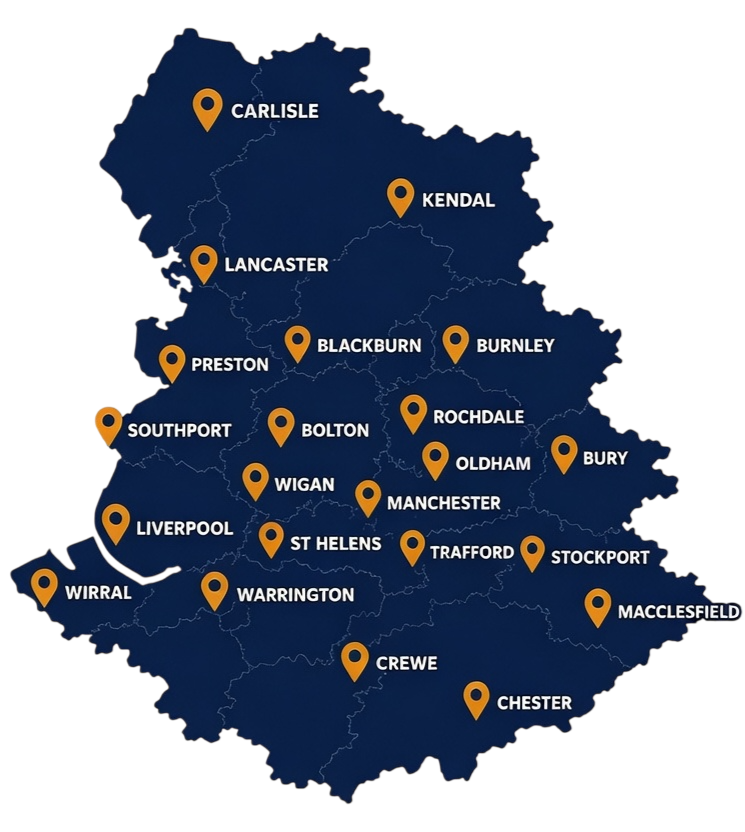
BWSL arranges hazardous waste collections across the entire North West region:
Greater Manchester — Manchester, Salford, Trafford Park, Stockport, Oldham, Rochdale, Bolton, Bury, Wigan, Tameside and all surrounding areas
Merseyside — Liverpool, Wirral, Knowsley Industrial Estate, St Helens, Sefton and surrounding areas
Lancashire — Preston, Blackburn, Burnley, Leyland, Chorley, Lancaster and surrounding towns
Cheshire — Warrington, Chester, Crewe, Macclesfield, Ellesmere Port and surrounding areas
Cumbria — Carlisle, Kendal, Barrow-in-Furness and surrounding areas
The BWSL Plant a Tree Scheme
Every tonne of hazardous waste we divert from landfill on your behalf earns your business a native British tree — planted right here in the North West. Fully funded by BWSL at no extra cost to you. Because responsible hazardous waste disposal should also contribute to a better environment.

Frequently Asked Questions — Hazardous Waste Disposal North West
-
A consignment note is the legally required document for every movement of hazardous waste in England. It must be completed before collection, signed by both producer and carrier, and retained by the producer for a minimum of three years. Missing consignment notes are one of the most common hazardous waste compliance failures and are checked as standard during Environment Agency inspections. BWSL issues fully compliant consignment notes automatically on every hazardous waste collection.
-
A European Waste Catalogue code is a six-digit code that identifies the type and source of your waste and whether it is classified as hazardous. EWC codes must appear on consignment notes and are used by permitted disposal facilities to confirm they are authorised to accept your specific waste type. BWSL helps every client identify the correct EWC codes for their waste streams before arranging collection.
-
The requirement to register as a hazardous waste producer was removed in 2016. However, all duty of care obligations that apply to hazardous waste producers remain fully in force — including correct classification, licensed carriers and consignment note documentation on every collection.
-
Hazardous waste must be stored in UN-approved containers that are compatible with the specific material. Liquid hazardous waste should be stored in a bunded area. Containers must be clearly labelled. BWSL supplies appropriate containers for every waste stream and advises on correct storage during the free waste audit.
-
No — different categories of hazardous waste must be segregated. Mixing hazardous waste streams is illegal, changes the waste classification and can cause dangerous chemical reactions. BWSL advises on correct segregation for every waste stream during the free waste audit.
-
Yes — BWSL arranges collections for businesses producing small quantities of hazardous waste as well as high-volume producers. We also arrange one-off collections for businesses that generate hazardous waste occasionally rather than regularly.
-
No. BWSL operates on a 30 day rolling notice period. Cancel or amend hazardous waste collections with just 30 days notice — no exit fees, no penalties.
-
Appropriate containers can typically be delivered within 48–72 hours of accepting your quote for most hazardous waste streams. First collection is usually arranged within 5–7 working days.
-
Yes — BWSL coordinates collections for multiple hazardous waste streams, ensuring each is correctly classified, correctly packaged and routed to an appropriate permitted facility. All collections consolidated onto one monthly invoice.
-
Hazardous waste in a general waste bin is an offence under the Environmental Protection Act 1990 and the Hazardous Waste Regulations 2005. General waste facilities are not permitted to accept hazardous materials — contaminated loads are rejected and may result in additional charges, enforcement action and Environment Agency investigation. BWSL's free waste audit identifies any hazardous materials incorrectly going into general waste streams before they become a compliance problem.
-
BWSL's network buying power typically results in 15–25% lower pricing than businesses achieve going direct. Additionally, BWSL manages the full compliance process — EWC code classification, container supply, consignment note completion and facility routing — reducing the administrative burden on your team significantly.
Get Your Free Hazardous Waste Disposal Quote Today
Whether you produce waste oil, solvents, batteries, WEEE, asbestos-containing materials, chemical waste or any other hazardous material — BWSL has the expertise, the network and the compliance knowledge to manage your hazardous waste correctly, compliantly and at a lower cost than you're currently paying.
EA-registered carriers. Correct EWC codes. Consignment notes on every collection. 30 day rolling notice. One invoice.